Artist Profile - Wang Wei
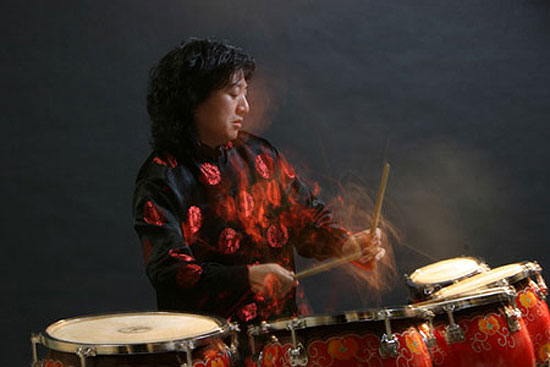
Wang Wei's musical career started when his father taught him the yangqin, the Chinese hammered dulcimer, at the age of 4. His musical talent and accomplishment in the instrument was acknowledged at the China Music Conservatory, where he attended middle and high school from 1983-1989. During that time, he began to explore percussion, studying with Zhu Xiaolin, a master Chinese percussion, and Fang Guoqing, a master in Western classical instruments, including the xylophone, marimba, and snare drum.
Graduating first in his class, Wei was immediately accepted to the Shanghai Conservatory of Music. There he trained under the best percussion teachers in Shanghai, continuing his studies in Chinese percussion with Li Mingxiong and Western percussion with Xue Baolun. After graduating in 1993, he joined the Shanghai Song and Dance Ensemble as their only percussion soloist.
In 1994, Wei joined musicians from Germany, Inner Mongolia, Nanjing, Chengdu, and Hangzhou to form an East-West ensemble called Crossing. Together, they won first place in the 1994 Beijing Jazz Competition. In 1996, Wei was awarded a two year Deutscher Akademischer Austauschdienst (DADD) scholarship which allowed him to study and perform in Berlin. This German Academic Exchange Program made possible musical exchanges between Germany and other countries. During those two years, he worked with many other musicians and performed for such notables as the president of Germany.
Wei, as part of the trio Omen, won first place at Berlin's prestigious World Music Competition in October of 1996. In 1998 after completion of the scholarship, Wei attended the Berlin Conservatory of Music, becoming the school's first student ever to pursue a double major program in both jazz drums and hand drums/world percussion. After his graduation in 2000, he was invited by the Berlin Philharmonic Orchestra to perform as a guest bangu soloist with Maestro Kent Nagano in the "Rhythm and Dance" Concert.